

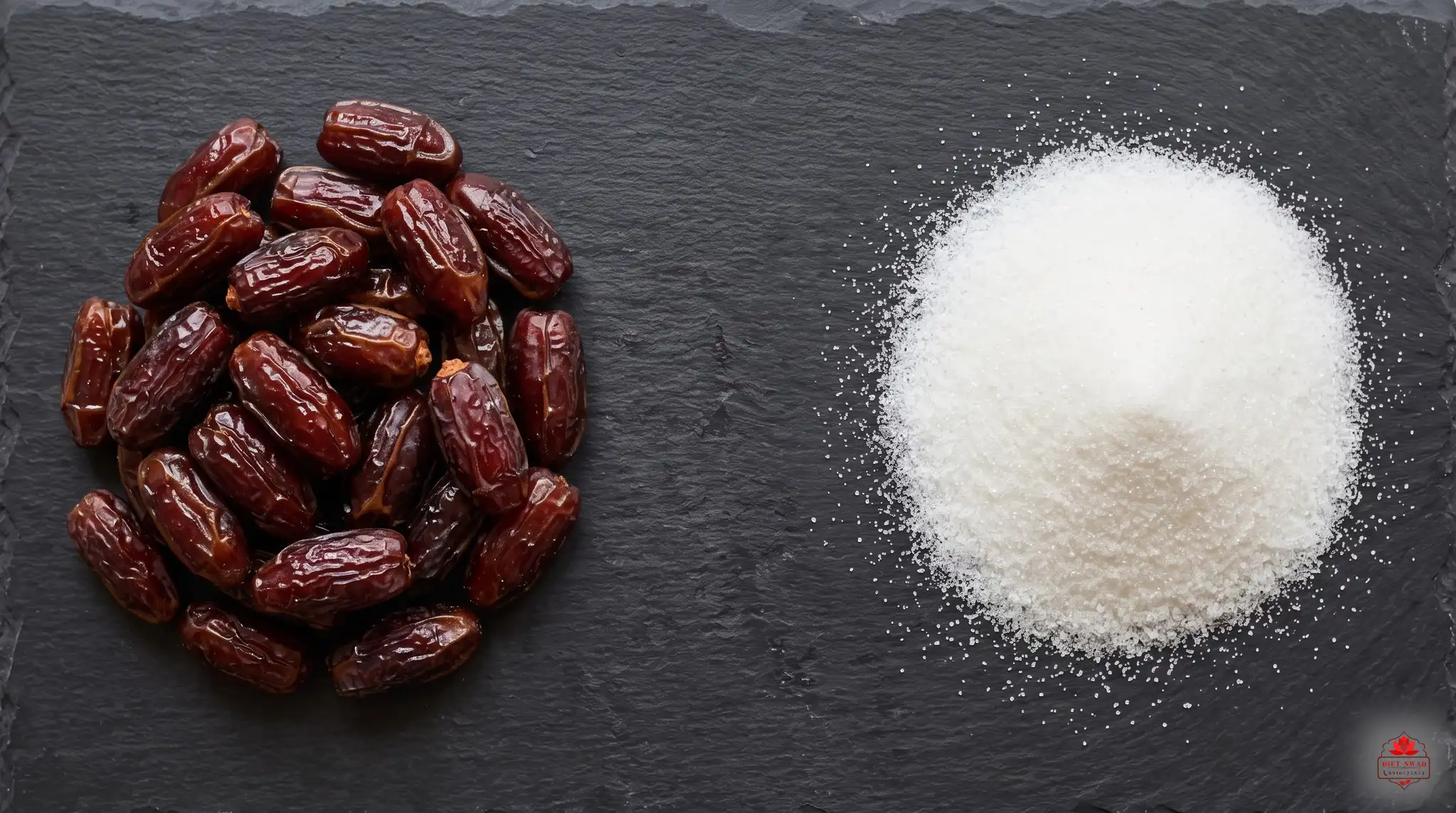
A date is roughly two-thirds to three-quarters sugar by weight. That is a real number and we are not going to soften it. Yet when researchers actually measured the glycaemic index of common date varieties, the results came out in the low band.
Both things are true, and the reason why is genuinely interesting. It turns on the difference between how much sugar a food contains and how fast that sugar arrives.
First, what glycaemic index actually is
Glycaemic index, or GI, is a score from 0 to 100. It ranks how quickly a carbohydrate food raises your blood glucose compared with a reference food, usually pure glucose at 100.
- 55 or below is classed as low
- 56 to 69 is medium
- 70 or above is high
The crucial part, and the part that trips almost everyone up: GI measures speed, not quantity. It says nothing about how much sugar is in a portion. It only describes the shape of the curve after you eat it. Kitna nahi, kitni jaldi.
An easy way to hold the distinction. Watermelon has a fairly high GI but very little carbohydrate per slice, so a normal serving barely moves anything. A food can be fast but small, or slow but large. GI only tells you about fast versus slow.
What the study found
The reference point most people cite is a 2011 paper by Alkaabi and colleagues in Nutrition Journal. The researchers tested five common date varieties in both healthy participants and participants with diabetes.
In healthy participants the glycaemic indices came out between 46.3 and 55.1. In participants with type 2 diabetes they ranged from 43.8 to 53.0. Both ranges sit at or below that 55 threshold, which is the low band.
That is a genuinely counterintuitive result for a fruit that is mostly sugar, and it is worth attributing properly rather than repeating as folklore. It is one study, published in 2011, on five varieties, and it is describing whole dates eaten as dates.
So why is it slow?
Three things are happening inside the fruit.
- The fibre. USDA figures put Medjool dates at about 6.7 g of fibre per 100 g. Fibre physically slows down digestion, so the sugar is released gradually rather than all at once.
- The structure is intact. The sugar in a date is held inside actual fruit tissue that your gut has to break down first. Table sugar has no structure to dismantle, so it is absorbed almost immediately.
- The type of sugar. Dates carry a good proportion of fructose, which is metabolised differently from glucose and raises blood glucose more slowly.
Put simply: the sugar in a date has to be excavated. The sugar in a syrup is already free.

Now the part most articles skip
A low GI does not mean unlimited, and it does not mean the sugar has gone anywhere.
- The calories are still there. Around 277 kcal per 100 g for Medjool dates. Slow energy is still energy.
- Portion still decides everything. A low-GI food eaten in a large quantity will affect you more than a high-GI food eaten in a small one.
- GI is measured for a specific food in a specific form. Grinding, blending, heating or mixing a food with others changes how fast it digests. A figure measured for whole dates does not automatically carry over to anything made from dates.
- People differ. Individual glucose responses to identical foods vary considerably, which is a well-documented and slightly inconvenient finding.
The same 2011 trial also reported that date consumption by participants with type 2 diabetes did not produce significant post-meal glucose excursions. We are deliberately not building anything on that sentence. It is a research finding about a controlled trial, not advice, and it is not a claim we are entitled to make about food we sell.
If you are managing diabetes, please take this question to your doctor or a registered dietitian rather than to any brand's blog, ours included. Dates are high in sugar, portion size matters, and your situation is specific to you in ways an article cannot account for.
What this is actually useful for
The practical value here is not a permission slip. It is a better mental model.
When you look at a nutrition panel and see a large "of which sugars" number on a date-based product, that number is honest and it is also incomplete on its own. It cannot distinguish between sugar that was stirred in and sugar that grew inside a fruit surrounded by fibre. Those two behave differently, and the ingredient list is what tells you which one you are looking at.
Which is the same conclusion as always: read the number and the list, never one alone.
Products where dates are the sweetener

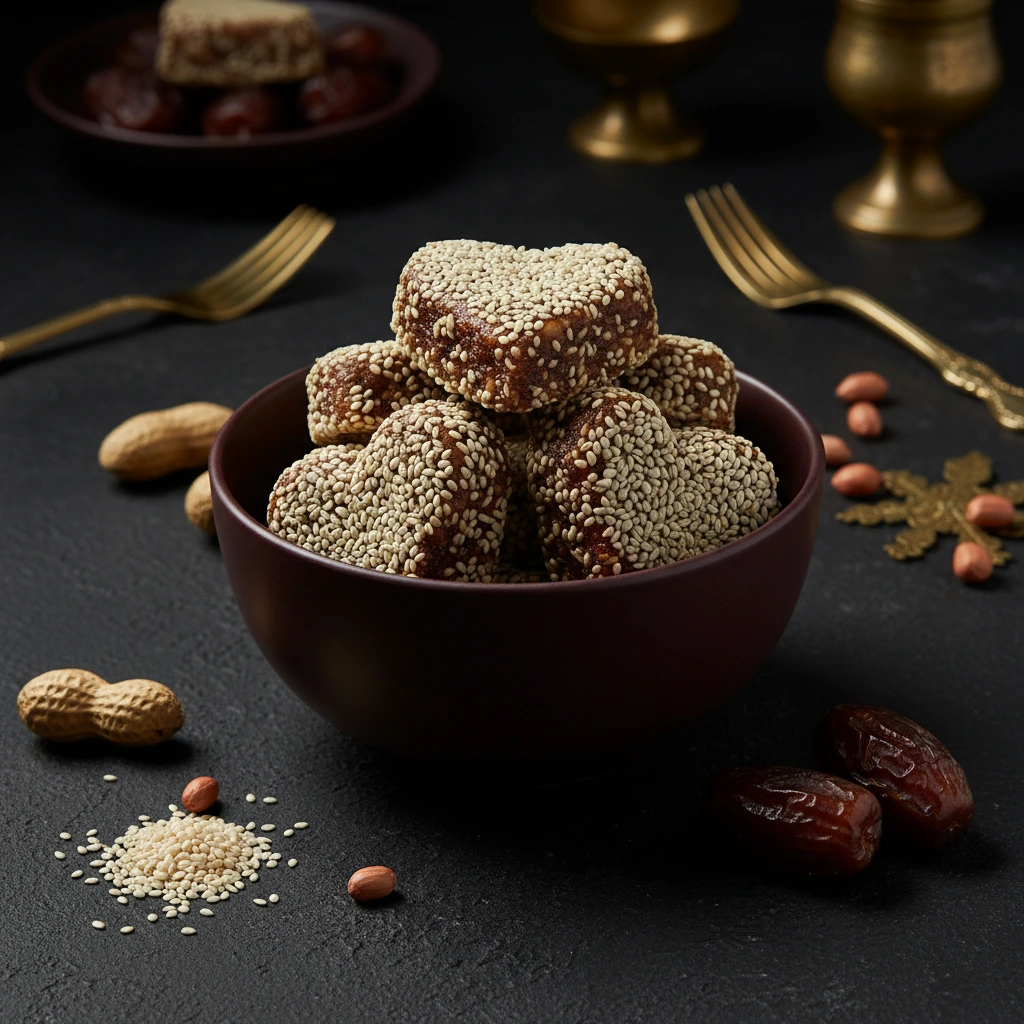
To be completely clear about our own products: their sugar figures are high, and that is because dates are high in sugar. We have not had their glycaemic index tested, so we are not going to imply they are low-GI or suitable for anyone managing blood sugar. What we can tell you is exactly what is in them and in what proportion, which is printed on the pack.
Frequently asked questions
What is glycaemic index in simple terms?
Glycaemic index is a score from 0 to 100 that ranks how quickly a carbohydrate food raises blood glucose compared with a reference food. A score of 55 or below is classed as low, 56 to 69 as medium, and 70 or above as high. It describes the speed of the rise, not the amount of sugar in the food.
Do dates have a low glycaemic index?
A 2011 study published in Nutrition Journal measured five common date varieties and found glycaemic indices between 46.3 and 55.1 in healthy participants, which falls in the low band. This is a finding about whole dates in that trial, and it should not be assumed to apply to any product made with dates unless that product has been tested itself.
How can something 70% sugar have a low GI?
Because glycaemic index measures speed, not quantity. In a date the sugar sits inside intact fruit tissue alongside fibre, which slows how quickly it is broken down and absorbed. Total sugar and speed of absorption are two different things, and a food can be high in one and low in the other.
Can people with diabetes eat dates?
This is a question for your doctor or a registered dietitian, not for a snack company. Dates are high in sugar and portion size matters a great deal. Anyone managing diabetes should follow the advice of their own healthcare professional, not a general article.
Does glycaemic index still apply when dates are in a snack?
Not automatically. Glycaemic index is measured for a specific food in a specific form, and blending, grinding, heating or combining a food with others can change how quickly it is digested. A GI figure for whole dates cannot be transferred to a date-based product that has not been tested.
Two numbers, two different questions
How much sugar is in this, and how fast does it arrive? Most arguments about dates happen because people are answering one question while thinking they are answering the other.
Dates are high on the first and, in the research that exists, low on the second. Dono sach hai. And a portion is still a portion.
Related reading: Arabian dates vs local dates covers how to buy the good ones, and jaggery vs refined sugar vs desi khand applies the same honesty to the other sweeteners.
Sources
- Alkaabi JM, et al. Glycemic indices of five varieties of dates in healthy and diabetic subjects. Nutrition Journal, 2011;10:59. pmc.ncbi.nlm.nih.gov/articles/PMC3112406
- USDA FoodData Central. Dates, medjool (FDC 168191): energy, fibre and potassium figures. fdc.nal.usda.gov
Diet Swad products have not been tested for glycaemic index and no GI claim is made for them. Anyone managing diabetes should go by their own doctor's advice here.